
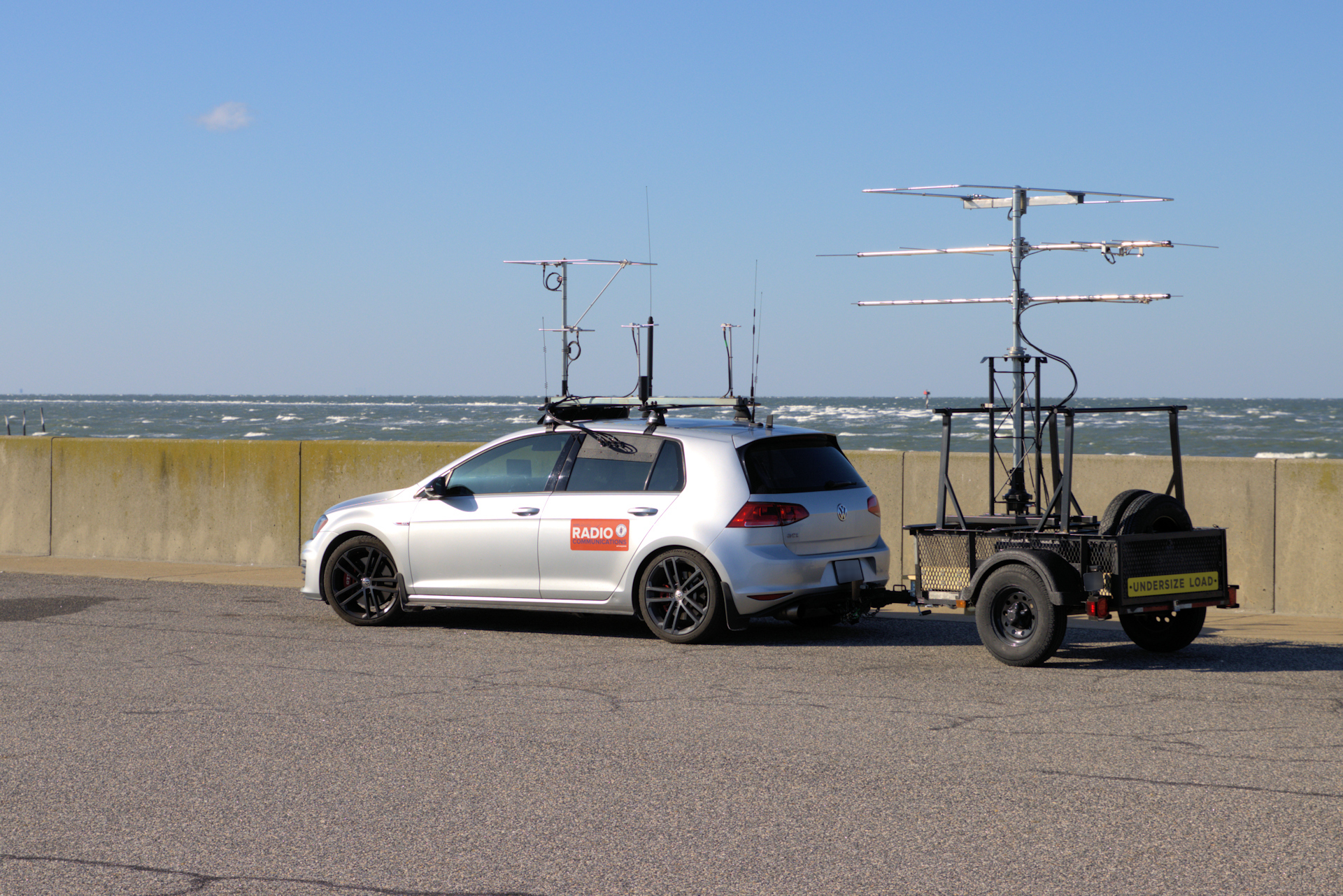
 Happy New Year! Yes, I know I’m a bit late. I’ve been both busy and distracted. I mentioned my decision to build a tower trailer in November. I can’t believe it’s been so long already! What have I been doing to make progress on the trailer build? Well, there was a slow grind toward getting my feed lines rerouted to the rear bumper. Rather than reroute, I decided to purchase new feed lines and route them as additional cables. I also added four 4-ft sections to couple the trailer to the car. One of my greatest delays was due to my indecisiveness about whether I wanted to add Type-N fittings to the rear bumper or just run with loose cables that I’d tuck when not in use.
 As ARRL’s January VHF contest approached, it came time to make a decision and get the setup ready to roll. I opted against drilling holes in the rear bumper valance since the ports would only be used a few times per year. In fact, my involvement with two bicycle touring companies in 2024 will preclude me from participating in ARRL’s VHF contests in June and September; plus, I will miss Hamvention and other ham meets. I expected that it would be a long time before I’d feel a benefit to having coaxial ports on the bumper valance. So, I quickly ordered some 4-ft LMR-240 extensions with female Type N connectors to go outside, then routed them through grommets in the trunk floor.
 The connections at the trailer were fairly crude, but effective. I took four Type-N panel mount adapters, passed the fronts through the trailer’s side mesh, and then backed the rear with 5/8″ flat washers. I was considering a different option that looks better, but adding more material to the front of the mesh reduces the available thread for the feed line. So, this is it! The 4-ft sections of feed line are then routed along the trailer’s tongue to the female Type-N’s shown above. The rotator control cable is shown, too. I considered cutting the cable in the middle to add a connector. However, I decided against it since I still had other ideas.
 I received a pleasant surprise phone call from Andrea, K2EZ, as the contest approached. Andrea is an accomplished contest rover who commutes frequently between New Jersey and Texas. She coordinates her commutes with the VHF contests. Her mega-rove usually takes her through western Virginia and not far from my extended contest rove. She wanted to meet so that we could rove together for a bit. Rovers who travel together are able to compound their points by using a technique called “grid circling.” Grid circling works best with four rovers since it allows one rover to remain in each Maidenhead grid square, everyone works each other and other stations, rotate, and do it again. This photo shows an example. A group of four limited rovers (50, 144, 222, and 432 MHz) would potentially have 64 combinations in each grid, if range and terrain allows, plus whatever contacts are made with fixed stations. Andrea and I were able to achieve 16 combinations in each of the four grids that we roved: FM08, FM09, FM18, and FM19.
 We had planned to work in FM07, too, but it was 11pm by the time we finished with FM08. I didn’t want to stay in a hotel and opted to drive home. I arrived at 2:30am! The sun woke me at 7:30am and I was on the road toward Chincoteague before 8am. I made a few contacts from my home grid, FM17, as well as FM16 as I made my way toward the Chesapeake Bay Bridge-Tunnel. I stopped at a scenic overlook for some cold and windy photos as well as a few contacts. I was in contact with four other hams as I traveled north on Hwy 13. I even met a fellow ham traveler along the way.
 I don’t recall if I made any contacts from Chincoteague. My main goal was to visit Chincoteague National Wildlife Refuge. This photo shows me on the beach on Assateague Island in grid FM27. I continued north through grid FM28 and made some contacts. I had planned to visit a rest stop at the edge of FM29, but I learned that the area was closed. I was not interested in operating nearby in the dark. So, I abandoned that portion of my rove and returned home via Annapolis, FM18, FM19, and then my home grid in FM17. I had a few stations that I contacted in each grid along the way. I arrived at home around midnight.
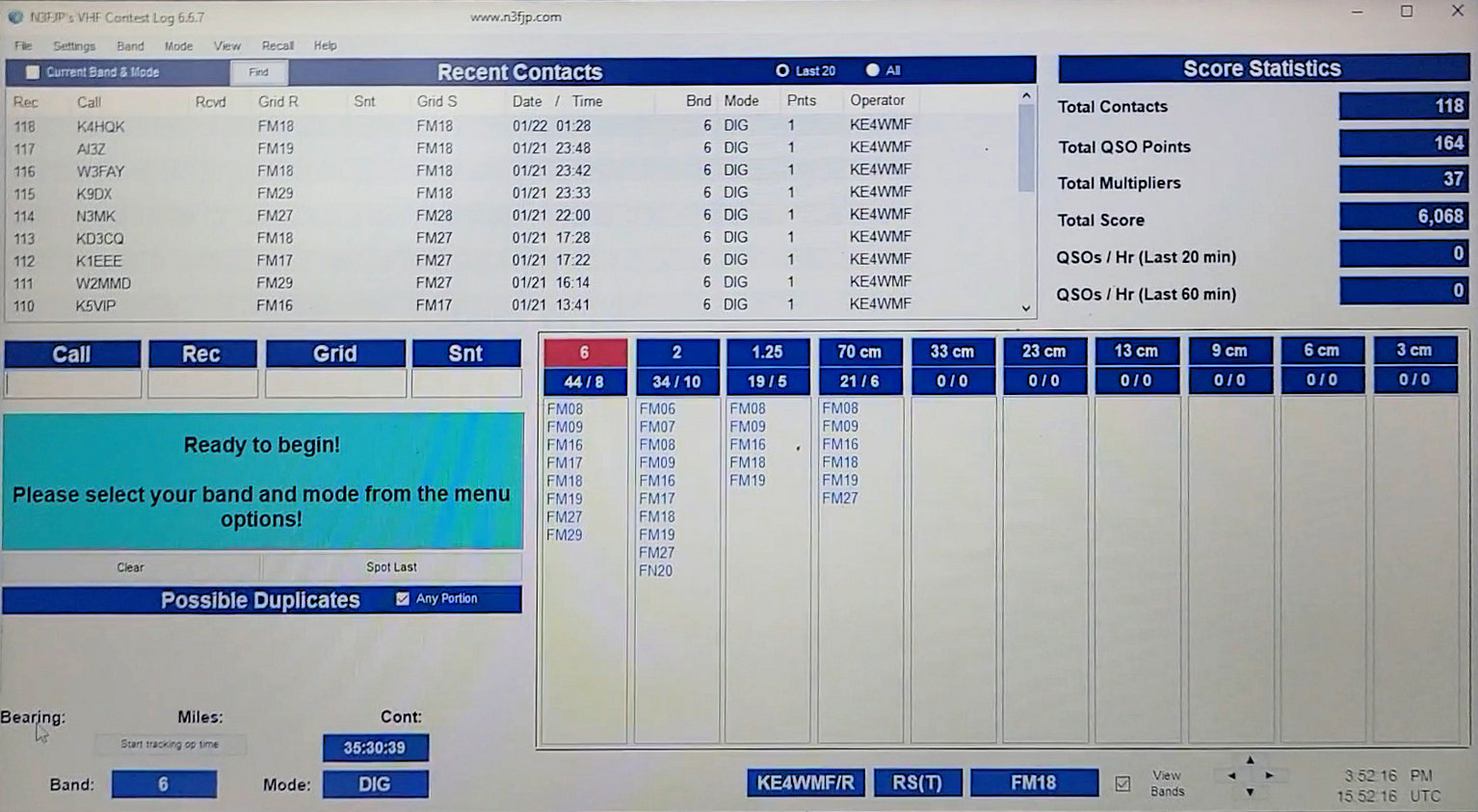 Overall, I roved in eight Maidenhead grid squares and made 118 contacts in ten grids, 99 voice contacts and 19 on FT8. That’s not enough to elevate me to super-rover status, but it’s my best achievement in a contest so far. All I ever want during a contest is to do better than I had before. Andrea had shared with me that FT8 seems to have taken over VHF contests, particularly on 50 MHz. As a result, she makes most of her contacts on 144 MHz and considers 1.25m to be her strongest band. I forgot to mention that I borrowed a 1.25m FM radio just for the contest so that I could work her at the grid corners. It turns out that I made quite a number of contacts on 223.5 MHz. Perhaps “222 Life” will be better with a transverter and a Yagi!
 Lessons learned: I think I need to rove less and talk more. This route accounts for over 900 miles of driving! I don’t usually make contacts while on the move. So, I don’t make points if I’m driving. On the other hand, I can’t get grid multipliers if I stay in one place and don’t move between the grids. It’s a balancing act that I’m still trying to perfect. Someday, I’ll approach a contest without irons in the fire and make a good plan ahead of time. 😀 See this video for more info about my contest experience. Next, the trailer’s got to go! Don’t get me wrong, it was functional and convenient during setup/teardown. However, during a contest, having the ability to quickly change directions or stop in a tight spot is almost critical. Although I can execute a three-point turn with the trailer in tow (I do them backwards), it’s VERY difficult in the dark since the trailer is small and black. The trailer also adds to fuel and toll costs. As a result, I’m going back to a rooftop setup. See this video for more details about this decision.
 You may recall that I had suffered minor fatigue in the internal components of my roof rack. I’ve designed a replacement “micro-tower” that I hope will mitigate that challenge. I’m modeling it very closely after my original micro-tower, shown here without the horizontal loops. I’m removing ~18 inches from the mast, which I hope will reduce the leverage that’s felt at the rack’s mounting points. I’ll share more about that project soon. My goal is to have it ready to transport in time for HamCation, which is about five days away at this point! The paint is currently drying and assembly will begin this weekend.
Down to Crunch Time!
Scott, KE4WMF/R


