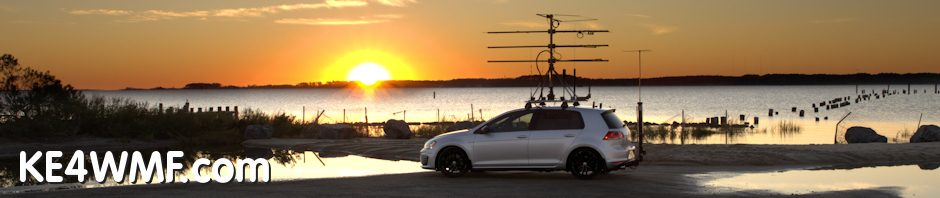
 It was just a few weeks ago that I finished installing my big battery upgrade. January’s contest is always a challenge: Unpredictable weather can make working on the car outside unpleasant, the evolving long-term weather forecast can make route planning difficult, and we never know what winter propagation will bring. This year was no exception because my planned route included snow in its forecast. Still, I wanted to try a 10-grid rove, which would require an overnight stay. But where?
 I enjoy visiting Chincoteague, VA, but lodging there is quite expensive with an exception: The town is very quiet during the winter months. As a result, hotel prices drop by about 60-70%, making it an attractive overnighter, particularly since Saturday’s a short day (contest starts at 2pm local time). With my overnight location chosen, I then planned a route that would make Chincoteague a logical stop. I planned Parks on the Air (POTA) activations from Chincoteague National Wildlife Refuge, US-0561, both an HF event and VHF/UHF. So, I left home around 5am on Saturday so that I could activate the park and still reach my first VHF contest location before 2pm. The photos above were taken during my crossings of the Chesapeake Bay Bridge-Tunnel (CBBT).
 I was on the beach by 8:30am for photos and then on the air around 9:15. My goal was to work several HF bands to achieve a total of ten bands from US-0561. I was surprised to see some activity on 80m and jumped at the opportunity to make some contacts before the sun was high enough to close the band for me. I did wind up staying a little later than planned because I was chasing two contacts for each band that I needed: 80m, 40m, 18m, 15m, 12m, and 10m. I had already worked on 20m during a previous visit and 30m was quiet. I left Chincoteague at 10:45am, stopped for lunch along the way, and arrived in FM29 around 2:30pm.
 My car is nearly ready to operate at all times. I was operating after erecting some shades, mounting a display, and tweaking a few applications. As usual, SSB was very quiet! I switched to FT8 and had my first contact in about 20 minutes. The fact that it took 20 minutes to find a contact on FT8 is an indication of sparse band activity! I sent a text message to a small group and eventually received a reply from K1TEO in Connecticut to arrange a “sked” on 144.205 MHz. We made contact, but quickly switched to FT8 for the other bands. We had no luck from any of my operating positions on 6m, but worked plenty on 2m, 1.25m, and 70cm.
 It’s relatively easy to stay close to grid square intersections along the Eastern Shores of Maryland and Virginia. I traveled through and made contacts from FM29, FM19, FM18, and FM28 before calling it a night. I intentionally avoided making contacts from FM27 on Saturday evening for two reasons: First, radio activity appeared to have dried up, so much so that I felt a need to return to the edge of FM28 the following morning for another shot. Next, I had planned to return to US-0561 for another POTA activation, this time exclusively on VHF/UHF. I wanted to ensure that all of my FM27 contacts were made from within the park.
 My choice of hotel was right outside the park and just 10 minutes from the beach. It’s away from most other island attractions, but that’s okay. Being there allowed me to get up early, load the car (including all equipment that I removed from prying eyes), grab a light breakfast, and then enter the park right as it opened at 6am. I was first to arrive in total darkness, heavy cloud cover, and rain showers. Only the occasional sweep of a nearby lighthouse provided even a hint of occasional light. That didn’t stop me from setting up the tripod to capture a nighttime photograph, though!
 This photograph was snapped as a long exposure with a small flashlight providing some foreground. I had to suppress the light emitting from the radios just to make this image tolerable! It’s a boring photo, but the image proved to be a good base for some fun with AI. Click the image to see the AI version… I think it turned out fairly well! Anyway, my first contact was at 6:30am and more trickled-in afterwards. I stayed for a couple hours and then returned to FM28, which was only 30 minutes away.
 I stopped alongside Wallops Island for this photo as I left Chincoteague. FM28 is just across the border into Maryland and yielded a few additional contacts. From there, I drove back down the Eastern Shore, across the CBBT, and into First Landing State Park, US-1299, in FM16. Next, I drove to the other end of the park in FM26 for more contacts. I left well before sunset so that I could navigate the unfamiliar roads without worrying about hitting any tree branches with my tower. I drove to Colonial National Historical Park, US-0016, in my home area within FM17. I’m very familiar with this park and know a few areas that are open to the public 24 hours per day. I made enough contacts there to activate the park as well as four others.
 My overall results are not awful. This contest yielded neither my best nor my worst January results. I roved through eight grids and worked 19, the farthest being ~1200 miles to Houston, TX on 6m FT8. Regardless, I enjoyed the weekend and look forward to my next planned contest, the Virginia QSO Party in March. OH – I may try my luck as an in-state Rover for the North Carolina QSO Party, also in March but three weeks sooner! I think I can make a decent route through some counties that are within a day trip of home.
First Contest of 2026 Done!
Scott


