
 It’s been a while since I last shared anything about my Scorpion mobile HF antenna. It’s too large to leave on my car full-time, especially since doing so blocks access to the hatchback. Still, it’s my go-to antenna when I want performance on the HF bands.
I had shared at some point that I upgraded my capacitance hat (caphat) to a 35-inch unit by W8UZZ. The 8-spoke hat created an electrically longer antenna (12-spoke hat shown here); however, the extra mass proved to be problematic at highway speeds due to excessive wind loading. At first, my observation only included slight bending of the antenna main shaft. I mitigated that by turning the antenna around, which bent it back into alignment over time. Unfortunately, I noticed cracks in the caphat’s hub during a 2024 road trip and had to retire it.
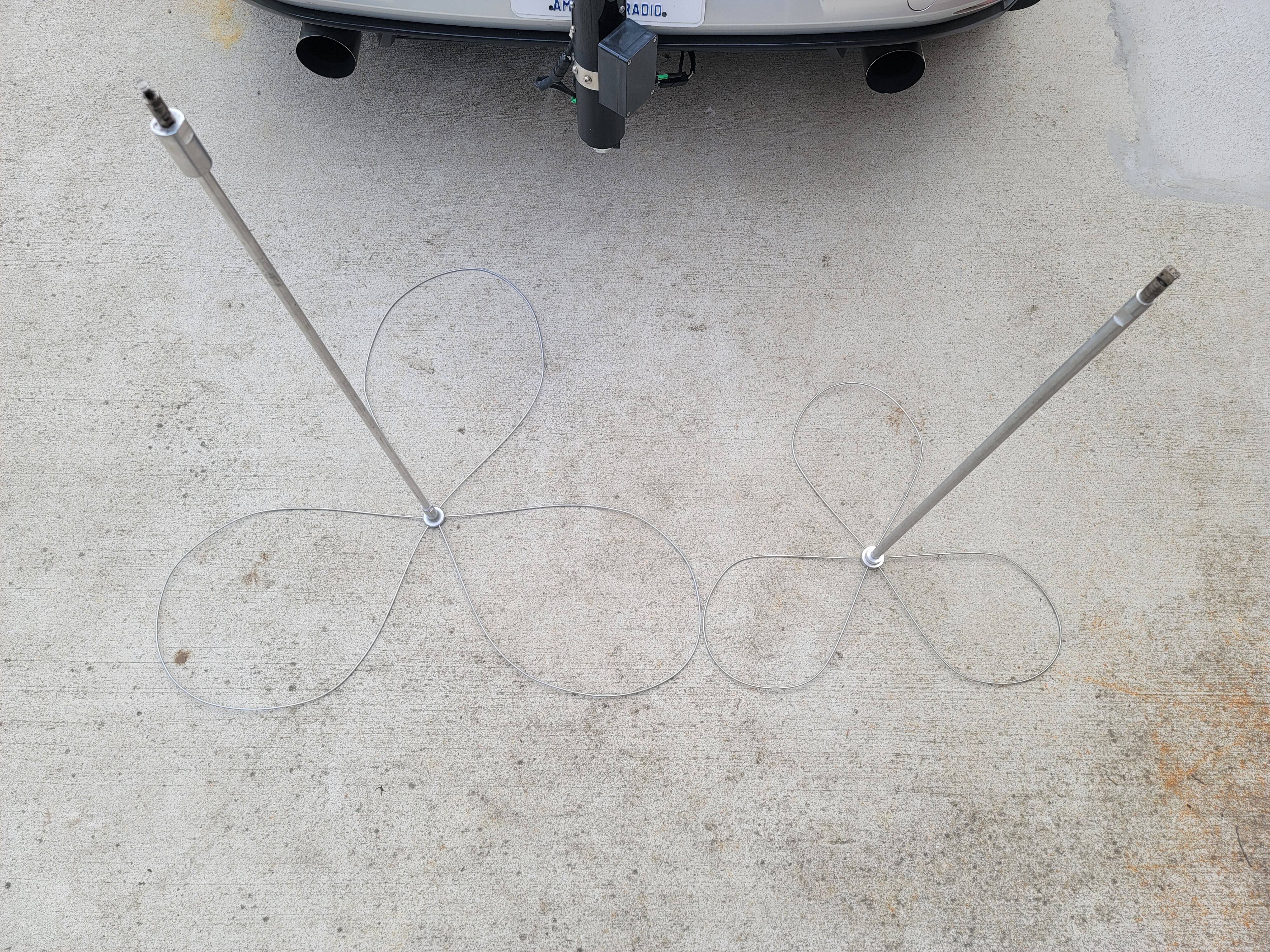
 Full disclosure: I was using one of W8UZZ’s old 12-spoke hubs to create a larger three-leaf clover design. My radials were smaller than the hub’s design intentions, ⅛-inch vs. ³⁄₁₆-inch… my abuse. Still, a close look at this photo reveals that the mounting holes are not centered in the thickness of the hub, leaving a very thin layer of metal to support the radials. I have no doubt that W8UZZ would have warrantied his work and sent a replacement if I had asked, perhaps after altering his design a hair, but I didn’t want another 8-spoke/ring unit.
 I think that the design has too much aerodynamic resistance at Interstate speeds. Of all the antennas flying above my car, the stress applied to the radiating element by that caphat was what concerned me most. I mounted my 67-inch whip for the Interstate portions of my solar eclipse trip in 2024 since I was on western roads with 75-85 mph speed limits. This photo shows the 67″ whip.
I mounted the Scorpion caphat on roads with speed limits of 70 mph or less while I considered alternatives. Oddly enough, there’s not a large market for mobile caphats! 😉 Doesn’t everyone put huge antennas on their vehicles?!? 😀
 Alan, K0BG, is a big proponent of cloverleaf designs due to their lower wind drag. After some experimenting, he settled on a 3-leaf design with 72-inch rods that resulted in an overall diameter of 5 feet. I searched for caphat hubs and found two options, one by Chameleon Antenna and one by DX Engineering.
I chose the Chameleon hub since it’s similar to Scorpion’s. The only drawback: Chameleon specifically advises against use while in motion; “base or portable only.” Considering that and the fact that their caphat is 32″ instead of 60 like Alan’s, what could go wrong? 😀 I decided to take a risk!
 Alan has a Scorpion antenna and is able to tune 17m with his 60-inch caphat. So it seemed logical that the same would work for me. NOPE! I have to assume that his truck’s bed-mounted antenna can tune 17m due to its improved efficiency when compared to my hitch-mounted antenna.
I snipped my radials 2 inches at a time until I was able to tune 17m. The end result was a caphat that’s 40 inches in diameter, 5″ larger than W8UZZ’s but lighter and more aerodynamic. Being made from W8UZZ’s radiator, Chameleon’s hub, and a local rod purchase, I call it “Frankenhat!” This photo shows the proximity between the new caphat and the Yagis during a VHF contest. I rotate the beams 30° left/right to help with tuning.
 The Frankenhat tunes from 17-80m or 18.200-3.400 MHz. Its tuning is not quite as “long” as the W8UZZ caphat, but it’s much longer than the Scorpion caphat and still longer than a 102-inch whip. The road-going clearance is 8’5″, which is still short enough to make it through most drive-thru lanes.
The radiator/hat combination has a quick-release coupling for parking structures, if necessary. The Frankenhat’s movement at highway speeds is almost non-existent while W8UZZ’s caphat swayed quite a bit. Yes, I could drive slower on the Interstates, but why would I do that if I can employ an antenna solution that doesn’t require it? 😉
 There always seemed to be a dance each time I connected my antenna: 1) Connect the coax while paying attention to proper seating of the PL-259; 2) Check SWR; 3) Get out of the car to disconnect and reconnect the coax, again while ensuring the connector is seated; 4) Get back into the car to check SWR; 5) Repeat steps 3-4 until SWR is good.
There HAD to be an operator error in there somewhere, right? Or perhaps the threads were corroded from weather? Still, I opted to replace the feed line with LMR-240 and Type N connectors. There’s no way for the Type N’s ground connection to not seat properly, even with corroded threads. Plus, the connectors are weather-proof! I almost don’t know what to do with all the extra time I have now that it tunes the first time! 😀
 I cannot publish new Scorpion content without sharing an unfortunate reality: Scorpion Antenna has gone out of business due to retirement of the owner! His antennas were said to be the best mobile HF antennas that money could buy. I tend to agree that the antenna is and has been great!
Unfortunately, the vast majority of replacement parts are no longer available… antenna owners are on their own. I will run my Scorpion antenna for as long as I can support it. This is a reminder that a “Lifetime Warranty” lasts only as long as the lifetime of the company or its sole proprietor (MFJ Enterprises, anyone?). I wish the owner the best in his retirement!
If I was shopping today, I’d consider Tarheel Designs in North Carolina or Tarheel Antennas (not the same company) in Missouri, whichever is closer to you. BTW, this caphat will work on the larger Tarheel antennas!
Let me know if you have any questions about this antenna or what to expect if you’re buying a used one. Scorpion antennas are unicorns now. I hope mine continues to be an example of excellence for a long time!
Overbuilt Antenna,
Scott
